Popular Searches
- Cancer Types
- Treatment
Popular Searches
- Cancer Types
- Treatment

Popular Searches
The thyroid is a butterfly-shaped gland located at the front of the neck, just below the voice box (larynx) and above the collarbones.
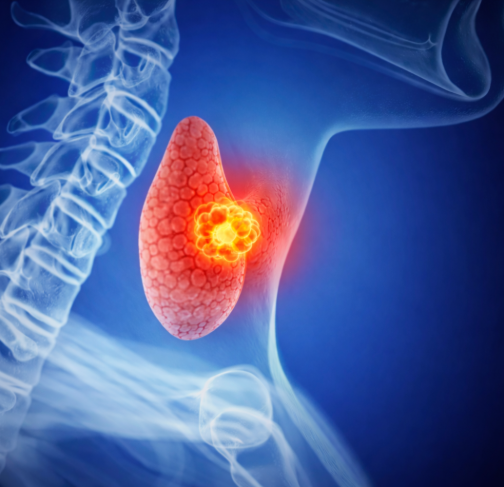
The thyroid is a small, butterfly-shaped gland at the front of the neck. It produces hormones that help regulate your body’s metabolism—affecting energy levels, heart rate, body temperature, and weight.
Thyroid cancer occurs when abnormal cells in the thyroid grow in an uncontrolled way and form a tumor. It is not among the most common cancers, but it is being diagnosed more often today because modern imaging and testing can detect thyroid nodules earlier. The reassuring part is that most thyroid nodules are not cancer, and when thyroid cancer is diagnosed, it is often highly treatable, especially when found early.
There are several types of thyroid cancer, and identifying the type helps guide the most effective treatment plan: Papillary (most common, ~80–85%); Follicular (~10–15%); Medullary (~3–5%); Anaplastic (rare, <2%).
At OncoClinic, we help you move from uncertainty to clarity—through precise diagnostics, clear explanations, and a personalized plan built around your specific diagnosis and goals.
Many thyroid cancers cause no symptoms at first and are often found during routine exams or imaging tests done for other reasons.
Routine screening is not recommended for the general population, but careful monitoring is advised for individuals at higher risk, such as those with a strong family history of thyroid cancer or a known genetic syndrome (for example, MEN2).
Thyroid cancer is often discovered when a lump or nodule in the neck is found during a physical exam or imaging test done for another reason.
Common tests used to diagnose thyroid cancer include:
A biopsy is the main test used to confirm whether a thyroid nodule is cancerous
Staging describes how far the cancer has spread and helps guide treatment decisions.
Thyroid cancer is staged from Stage I to Stage IV, based on:
At OncoClinic, we provide comprehensive, personalized care for thyroid cancer patients, utilizing the latest advancements in diagnostics and treatment options. Our approach includes:
Molecular and genetic analysis: Our clinic offers molecular and genetic testing of tumor samples to identify specific genetic alterations. This information helps refine treatment decisions and guide the use of targeted therapies or immunotherapy when appropriate.
Personalized treatment plans: After an initial consultation, we work closely with each patient to develop a personalized treatment strategy based on the type and stage of thyroid cancer, as well as individual health factors.
Surgery: Surgery is the main treatment for most thyroid cancers and is often the first step in care. When appropriate, it involves removal of part or all of the thyroid gland and, in some cases, nearby lymph nodes.
Radioiodine therapy: For selected patients, radioactive iodine therapy may be used after surgery to destroy remaining thyroid tissue or cancer cells. This approach targets thyroid cells specifically while limiting effects on surrounding healthy tissue.
Targeted radiation therapies: In certain cases, external beam radiation therapy may be recommended to treat thyroid cancer that cannot be completely removed with surgery or has spread to nearby areas, while preserving surrounding healthy tissue.
Systemic and targeted therapies: For advanced or treatment-resistant thyroid cancers, systemic treatments such as targeted therapy or immunotherapy may be used to help control disease and improve outcomes.
Multidisciplinary care: Our team consists of thyroid cancer specialists, surgeons, oncologists, radiologists, and genetic counselors who work together to deliver comprehensive care. We also offer support services, including nutritional counseling and emotional support, to help patients through their treatment journey.
We are committed to providing compassionate, advanced care, ensuring the best possible outcome for each patient.
Thyroid cancer overview
American Cancer Society, 2026
Thyroid cancer risk factors
American Cancer Society, 2026
Thyroid cancer types
American Cancer Society – American Cancer Society, 2026
Thyroid cancer – patient version
National Cancer Institute (NCI), 2026
Thyroid cancer treatment (PDQ®) – patient version
National Cancer Institute, 2026
NCCN clinical practice guidelines in oncology: thyroid carcinoma
National Comprehensive Cancer Network (NCCN) – NCCN, 2026
2015 American Thyroid Association management guidelines for adult patients with thyroid nodules and differentiated thyroid cancer
Haugen BR et al. – Thyroid, 2016
Revised American Thyroid Association guidelines for the management of medullary thyroid carcinoma
Wells SA et al. – Thyroid, 2015
2021 American Thyroid Association guidelines for management of anaplastic thyroid cancer
Bible KC et al. – Thyroid, 2021
Thyroid cancer statistics
Surveillance, Epidemiology, and End Results (SEER) Program – National Cancer Institute, 2026